Tuesday, August 28, 2012

Preparing for Isaac


Having lived on the east coast of Florida for several years, including the summer of 2004 when we were pounded with one hurricane after another, I am fairly practiced at preparing for a hurricane. What makes this one different, is that I have never had this many animals in my care at the time of a hurricane, or this much property to secure. Last time I lived in an apartment and had 2 pets, a parrot and a rabbit, both of which were inside. Now I have over 20 chickens, 13 turkeys, 3 dogs, and about 12 acres to keep up with.  I began preparing several days ago, when Isaac was expected to be a category 2 and headed straight toward us. Now, thankfully, it has been downgraded to a category 1 and moved to the west a bit. We still need to prepare to have power outages, high winds, possible tornadoes, flooding, and no access to supplies. I always like to prepare for the worst and hope for the best. The winds have gotten strong already. The chickens are free ranging still but will be locked up where it is safe in a couple of hours and will remain there until the storm has passed.  

The chicken coop has been tied down. We are worried about the tin roof remaining intact during the storm so we secured it. The coop has an automatic waterer, but a regular gravity waterer has been placed in the coop to prepare for the loss of electricity. We have well water so no electric, no well pump, and no water. Extra feeders have been placed in the coop to ensure that they will have plenty of food if it isn't safe for me to go out and feed them in the morning. 


A cattle water tub was brought over and filled so that we will have plenty of water for the animals. I'm expecting it to finish filling during the night, as we are going to have LOTS of rain. 


The turkey hoop coop has been evacuated. It is built to be light so that it can be moved around the yard easily. This means that in high winds, it just isn't safe. The tarps were removed so that they don't catch wind. Hopefully it will hold up through the storm. 


This is where the turkeys will ride out the storm. A cattle/horse trailer. It is sturdy enough to withstand the wind, and possibly downed limbs. It also has a middle divider so that if we need to leave, we can close the turkeys in one side, put the chickens in the other side, hook up to the truck, and all of us can go. 
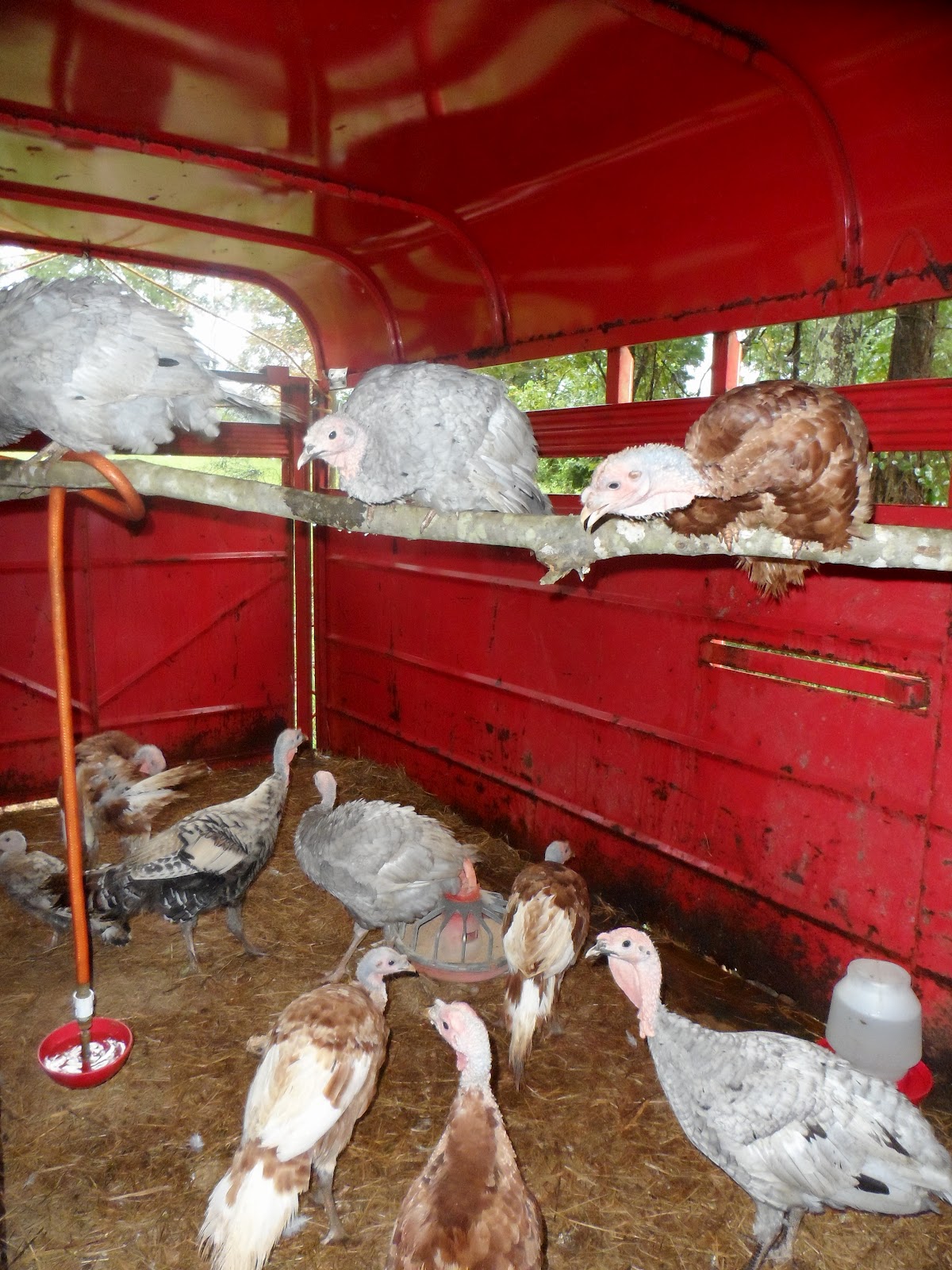

The turkeys seem to enjoy the new settings. They are so curious. I had to rig the back of it because they had figured out how to escape. Who ever said turkeys are stupid have clearly never been around heritage turkeys before. They are too smart for their own good sometimes. I moved their automatic waterer to the trailer, but also gave them a gravity waterer and extra feeders. We also stocked up on chicken feed, turkey feed, and dog food when we were stocking up on canned food and water for ourselves. They are good to go!


The first feeder band made its way through as I was finishing up. We already had our first tree casualty. This was a large Oak. Luckily it was away from the house and fell into a wooded area. Hopefully we won't loose many more. Time to hunker down for the storm!


Monday, August 20, 2012

The Turkey Heads Are Getting BIG!

This is the most curious turkey. He isn't scared of anything and always
has to come see what is going on. He is also the worst about biting (tasting).
He thinks that everything is food. Narragansett 11 weeks.
One of the blue slates had to come see what was happening too!
Bourbon Reds. They still all want to see what the camera is every
time they see it. It usually means they want to taste it. 
Nosy Nosy Narragansett
Poor little Igor is now half the size of the rest of the turkeys. We have discovered
that it is not her neck, but her leg and breast bone, that are growing crooked.
She will likely have to be put out of her misery at some point but for now she is
getting around well enough and the others watch out for her.
7 Weeks

Some of the babies free ranging in the yard. Around 7 weeks old.
Even with the best of intentions, sometimes things don't get done. I had planned on posting weekly pics and updates on the turkey poults. That turned into biweekly posts. I'm not the best at keeping up with writing things when there are so many other things that need to be done around the homestead. I'll save all of that for another post, though. The babies are almost 12 weeks old now! When they were about 7 weeks old I started putting them in the chicken hoop coop during the day while the roosters were roaming the property. They were just too darn big to leave in the brooder coop anymore. I began letting them out in the yard when I was out there watching them. They never went more than a few feet from me. I assumed that if I was right beside them, they would be safe. Boy, was I wrong! I was sitting at my stone table, which is surrounded by a flower garden (my serenity garden). Half of them were under the bench I was sitting on and the others were right beside me. I was bent down talking to one of the blue slates (baby talk... its sickening I'm sure) and a swoosh of brown feathers flew by my face. I opened my eyes to see a hawk turn his head around and stare at me from atop my poor poult! He wasn't more than a foot and a half from my face! I grabbed the closest thing to me and swung it at him, while trying not to hit the turkey, and the hawk flew off leaving the poult there. The baby jumped up and ran back over to his brooder, along with the rest of them, and begged to be put back. Hence, no more free ranging turkeys for a while. I assume that the chickens are just too fast for the hawk, although we only have 6 chicks left. I think I know now where they all went to (aside from one that our new puppy got a hold of... there will be no more of that!). Now that all of the roosters have been sent to freezer camp (YAY!!!) the turkeys moved into the hoop coop full time. They have been the sole residents for about two weeks now. They are still super curious. They don't like being picked up quite as much as they used to, but they still come running over every time I get near the coop. Keegan says that they look like the flying monkeys from TheWizard of OZ when they are jumping and flapping around. I have to agree with him. I call to them (turkey turkey turkey!)and they all talk back. Keegan is the best at it, though. He figured out their alert call (by accident) and sent them all scattering. He can also get them to make several other calls and gobble. The time before last when I moved the hoop house, I broke one of the frame boards where there was a knot, so moving it got sidelined for a bit until I could fix it. Now they are moved onto fresh grass and LOVING IT! They are feathered out and beautiful! I can't believe that I was so worried about getting turkeys. They have been so much fun and are really not difficult to take care of at all. Now that I say that, though, something will happen... I encourage anyone that has to space to put them (and move them frequently because they get much more stinky than chickens if left in one area) to get them. They are no more difficult, so far, to take care of than chickens.

Saturday, August 18, 2012

Homemade Mayo!

Did you know that mayonnaise is made with raw egg yolk? I didn't either, until recently. I don't eat mayo very often, simply because it is so bad for you. I do love egg salad, though. It is my favorite use for fresh eggs. I love to boil a bunch of them, shell them, place them in a baggie or container, and graze on them for the next few days. Egg salad is so easy! It uses mayonnaise, though. I don't trust factory produced eggs and refuse to give my money to companies that treat animals the way that they do. As much as I hate to part with the very few fresh eggs that I am getting from my hens, right now, I think it is worth it. Making homemade mayonnaise is as simple as making egg salad.

The ingredients are:
One fresh egg yolk
1 cup Oil (I love having the option to use any oil I want instead of what is cheaper for the company)
Lemon juice (I usually don''t measure.. a splash? About 1 1/2 tsp)
Vinegar ( I also love being able to choose my vinegar. I use apple cider. Again, I don't measure. About the         same amount as lemon juice).


First, separate the egg. Keegan is always excited about
 getting the white. He knows how much great protein 
there is in it. 


 Next, whip the egg yolk. I prefer an electric mixer 
because it takes a while, but a whisk works. Whip the
 yolk until it starts getting thick. 


 Once the yolk gets thick, add the splashes of vinegar and 
lemon juice. Whip until it gets really frothy.

Once it is really frothy and getting thicker, start drizzling the oil in. 
Just add small amounts at a time, while mixing.  

 If you add the oil too quickly it will not thicken correctly. 
The more oil you add and the more you mix it, the lighter 
and thicker it will become.  

Once all of the oil is mixed in add salt and another splash of 
vinegar to taste. You can also add garlic and other spices
to make flavored mayo. 


Voila! Homemade Mayonnaise! To make egg salad, simply
add a dollop of the fresh mayo to a couple of hard boiled eggs. 
Add chopped onions, brown mustard, garlic, and paprika. 
Use a fork to crush and mix. Add to toast. :) 
As simple as that. SOOO Good!


This was the use Keegan put the egg white to. 
A fresh salad, tomatoes fresh out of the garden, onions
from our garden that we picked this spring, and scrambled egg whites 
topped with a splash of apple cider vinegar and ground pepper. 
Good choice :)

Chickens Lay Eggs

Greta: One of my Easter Eggers
Chickens lay eggs... common knowledge. Well, except for my hens apparently. They are approximately 22 weeks old. The time that hens begin to lay eggs varies by breed and by individual, but it is generally around 18-22 weeks. Most people would probably think that I was a crazy, but I am so excited about my hens laying eggs. Not just because I want to eat them (yum!) but because I have raised these girls from day old chicks and it is almost like waiting for your babies first words or steps. I know... crazy chicken lady, but I'm not alone. It is an exciting time! I AM excited about eating them, though. I can't bring myself to buy store eggs anymore so we have just been doing without since May, unless I can find a friend locally to let us buy some of their farm fresh eggs, which we have been lucky enough to do a few times.

About 2 weeks ago I was surprised to find a perfect beautiful little green egg in my nesting box. Imagine that! My chickens are so smart that she figured out exactly where to lay her egg without me showing her and having never done it before! Sounds silly, but it is impressive to me. I didn't expect the EE to be the first to lay. A few days later I found another pretty little green egg, and then a peachy colored one! Then, of course (I got too excited apparently) the Easter Egger that was laying my perfect green eggs went missing. We never found her and assume that she fell prey to our neighborhood hawk (another story). So back to one egg a day. I tried everything! I gave them treats (sunflower seeds, fruit, and veggies from the garden), I made sure the nesting boxes were clean and pretty, I checked all around the yard to make sure that they weren't laying them somewhere else... nothing. Now, they will lay when they are mature enough. I know that I can't convince them to do it because it isn't their choice, but I seriously thought about marching straight over to the coop with an egg basket in one hand and a frying pan in the other and telling them to make a choice. We are, afterall, paying their room and board with nothing in return!

The one laying hen that I have left has consistently laid every day, only missing a single day this week. My son figured out why, this morning, when he was making breakfast ( YES HE COOKS! I'm so proud!). He cracked the egg open, into the pan, and out falls another egg! He found an egg within an egg! This happens occasionally when a fully formed egg, for some unknown (to me, anyway) reason, turns around and heads back up the reproductive tract instead of down to be laid, and gets another white added to it. Once it gets back on its downward track, it gets another shell added, and then is laid. I wish I had gotten to him before he cracked the second one so I could get a picture. I have been hoping to find a double yolker at some point. I know that those are also common in newly laying hens. Two yolks leave the ovary at the same time, go through the process of having white added together, and are enclosed in a single (much larger) shell.

 This afternoon (my girls don't like mornings... they lay in the afternoon or evening) Keegan went out to check for eggs. He found one in the outer nesting box, and was happy to discover another lady in one of the inner nesting boxes! We got two eggs today!!! I am so happy! Small wonders. I am always reminded of the scene in Curly Top when Shirley Temple's character says "Oh my duck can do a wonderful trick! My duck can lay an egg!" The hateful headmistress asks "Well, what is so wonderful about that?" and Shirley replies "Well, can you lay an egg?". My chickens can lay eggs! Now if we can just get the other 11 ladies to catch on.

Einstein (my EE rooster) and some of the Buff Orphington ladies trying to find their way into my tomatoes. Bad bad chickens!

The ladies came to visit at the back porch. Surprisingly, they don't eat my potted herbs. 

Friday, June 29, 2012

2-3 week Turkey Update


The turkey-heads at 2 1/2 weeks. They don't hold still very often!

They always come over to see me when I get near the coop. 
Poor little Igor the Narragansett with the neck problem. His foot has since gotten better :) 2 1/2 Weeks
Bourbon Red Poult at 3 weeks


The turkeys are now 3 weeks old! I have been so busy that I missed the two week update. They have grown! At a week and a half old I moved them out of the indoor cage and into the outdoor tractor/brooder. They just didn't have enough room to move around as much as they needed to in the one and half foot by 3 foot ferret cage they were in. They peeped a lot and wanted a lot of attention, which I attributed to them being bored. The new set-up has a brooder box which measures approximately four feet wide by two and a half feet deep and has a slanted roof which is two and a half feet high at the tallest point and two feet high at the shortest. I moved the brooder lamp out with them but had to change the bulb from the 200 watt bulb I was using inside to a 60 watt bulb because it was so much warmer outside. The brooder has a hinged door which doubles as a ramp so that they can access the outer run. The run is completely closed in with chicken wire and measures 4 feet wide by 6 feet long and is approximately 2 feet tall. They have plenty of room to run and flap their wings now! I close them up in the brooder at night and open the hatch and allow them to move outdoors into the run but they still always have access to the brooder, where the food and water are located. At around 2 weeks old they started really playing with each other. They seem to try to tie each other up with their necks. They stand up super tall and chest bump, reminding me of adolescent guys when they get in each others faces. Some of the poults have started hanging their wings down to the ground, puffing their feathers up, and marching in little tiny circles around other poults which hunch down on the ground. They look like little tiny adult turkeys when they do it and I have even heard the faint sound of them drumming. I am assuming that the puffed up turkeys are the males and the ones that assume the more passive role, hunched down on the ground, are the females. I am looking forward to finding out if my assumption is correct. They have feathered out more extensively. They now have not only their wing feathers fully in, but also have tail feathers and are feathering out on their backs. Their tummy, chest, and neck are still covered only with baby fluff. The turkey-heads know my "call" of "turkey, turkey turkey" and come running to where ever I am closest when they hear it (funnily enough, so does the mocking bird who resides in my yard. He has started calling the turkeys too!). It makes it much easier to put them away for the night. I open the brooder, call them, they run in, and I shut the hatch. Much easier than the old way of picking each one up, putting it inside, and watching helplessly as it runs back out while I am picking up the next one. They also look forward to their daily treat of watermelon, which they get during the hottest part of the day to cool them down. The brooder is located under a large oak tree, in an area of my yard that is shady all day long, but it still gets warm in the southern Mississippi heat. I put pine chips in the brooder to absorb any waste that the messy babies leave. In the run I cut feed bags into long sheets and covered the ground and then placed hay on top of it to keep them from digging down to the soil. I am still worried about them getting blackhead from the chickens, or any other disease as their immune systems are not fully developed until they are around 8 weeks of age. I had to place wood and tin roofing over the run to keep the chickens from pooing down into the run since they insist on perching on top of it. They were living in there just a few months ago. The chickens have taken to standing outside the run and watching the poults. The roosters, especially, seem fascinated by them, and stand very still, right up against the wire so the poults can pull at their feathers. Surprisingly, they don't seem to be the least bit aggressive towards the turkeys. One of the turkey heads has something wrong with it's little neck and one of it's legs. It keeps its neck pulled all the way down to its chest and while it can extend it down to the ground to pick stuff up, it doesn't seem to be able to stand up straight.One if it's feet (where our ankles should be, a bird's ankle is actually what we would think of as a knee and it bends backwards) is swollen larger than the other. It just hobbles around, but is still eating and drinking properly. I've been keeping an eye on it but have decided to name it Igor and hope that it continues to function normally. The neck issue appears to be a permanent issue and although I think I would have noticed before last week, it looks like a problem that it may have hatched with. Only time shall tell how well it will do as it grows. As of now, they are all doing wonderfully and I am still really enjoying their bubbly little personalities.

My First Time Culling Chickens


Yes... I did the deed. I sent my first small batch (5) of chickens to "Freezer Camp". The roosters in question were becoming very aggressive and bullying the other chickens. One of them was aggressive toward me, as well. I always put the last of the chickens that are roaming around the coop into the coop at dusk so I can close them in where it is safe for the night. When I reached down to pick this one up he flew at my face, feet/claws first, flogged me, and left a 6 inch scratch down one cheek, Thankfully I backed up and turned when he started toward me because he nearly got me in the eye. I have never had one of my roosters attack me like that. I sat and watched the chickens, like I usually do, at dusk, and waited for them to go into the coop. Each time one of the bullies attacked another chicken I marked him with paint so I would know which  they were the following morning. Four of the five were white, which I thought was odd considering that there are a number of different breeds. Three of them were Red Star roosters, one was a white wyandotte, and the last one was affectionately called "hell Turken". I had always read that Turkens are really friendly, and the others in my flock are, but not this one. He bullied everyone, despite the fact that he was much smaller than them. The next morning my fiance, Brad, and I rounded up the roos that made the most wanted list and placed them in the recently vacated ferret cage, which became death row. The one that flogged me was first, because I was still pretty upset about him attacking me, and I thought it would be easier for me. I had only culled one other chicken. He had been brilliant and had eaten all but about 6 inches of a 7 foot long feed bag string that he had found laying next to the feed bag (who knew they would do that?!) and wasn't going to make it. It was mercy killing. I admit that, although I cussed and swore that I would enjoy dispatching that... darn... rooster the following night when he had flogged me, I cried and felt terrible when the time actually came. My main issue is that I am afraid that I won't do it right the first time and they will suffer. For this reason I decided that the best way to do it is to completely sever the head. They can't feel pain if the brain is not connected to the pain receptors in the body (I hope) and it is instant death. Brad held them upside down by the feet, which calms them a lot. I assume that it is because the blood rushes to their head and they get a bit whoosy. I prefer to think that they are whoosy, anyway, and would happily give them a drink to calm their nerves if I could. It would make me feel better. Brad insisted that I do the deed, which I understand. This was the intention when I ordered the chicks, and I have a lot left to send to "Freezer Camp", yet. If I don't get it over with now, I will never be able to do it. It was over pretty quickly. I held each one, petted it, and thanked it for giving its life to feed my family before it was dispatched, which may have made it harder to do, but I feel better about it in the end. After the head was severed, and muscle contractions ceased, they were hung upside down over a bucket to drain. Cleaning them was much easier, as they were no longer in pain and I could then stop looking at them as a live animal, but as food... or a cadaver. All of the dissection experience at school helped immensely, the pigeon from avian biology , in particular.The science part of my mind took over and it went from there. I plucked three of the white chickens, as they dress out better because of the feather color not leaving dark marks on the meat. I heated a large pot of water, dunked and swirled the chicken until I couldn't lift it by a wing feather without the feather coming out. This made it very easy to pluck the bird, as the feathers came out by the handful. I have considered going into more detail about cleaning the actual bird, including pictures, but I am still debating whether it would be appropriate to post. That may be a future post. After aging in the fridge for 48 hours, I was very pleased to be able to cook my family a dinner, made almost entirely from food that I grew myself. Chicken, green beans, onions, fresh basil and rosemary, and finally, potatoes and garlic (neither of which I grew.... next year!) all combined in a casserole dish and baked. It was amazing and such a satisfying experience. As much as I hate the culling part of the process, I love every other step, and the end result is worth it. Delicious chicken for my family, with more flavor than factory chicken, higher in Omega 3's, vitamin D, and many other vitamins and nutrients because it was free ranged, it lived a happy healthy life in the sun and grass, and died a quick and as pain free of a death as possible. Anyone can say I am cruel if they feel they need to, but I think that I have made not being a vegetarian as humane as it can possibly get, and for that, I feel wonderful.

Tuesday, June 26, 2012

Building an Above Ground Vegetable Garden

My new garden (2011) I had forgotten how sad, dead, and desolate it looked just last year! I have worked a lot on cleaning the tree line up and getting the grass to grow in the yard, as well as on the garden itself. It is AMAZING what a year can do!

The small garden and the new faucet I installed near the garden. THEN (2011)
and NOW (2012)

Along with the chickens, turkeys, and blueberries that I have been busy with, I also have a veggie garden (among my other gardens). I started out with a typical garden. The soil was tilled and seeds were planted directly into the ground. Unfortunately, nothing grew very well like that. The soil got compacted quickly because people were walking on it while tending to the plants. The soil, itself, was poor, and consisted mainly of red clay. The topsoil had been bulldozed off along with the trees that were standing there shortly before we moved onto the property. Hence, it was sitting in large piles along with the remnants of the trees. It is really difficult to amend a whole large garden's worth of soil! When the garden was watered, the water just puddled up in some placed, creating large bogs, and ran down the hill in others, creating huge ruts. Something had to give... One of the large piles of trees and soil that had been bulldozed where still in good condition, and were stacked neatly on top of each other. I measured 6 foot sections of the logs(except for two- 11ft and two-8 ft logs for the tomato garden), Brad cut them (as, while he lets me do most things, he won't let me use the chainsaw... pout), and we hauled them up the hill. My son, Keegan, and I measured 4 foot walk ways and laid the 6 foot logs into squares. Once the logs were placed into 8 perfect squares with pretty little walk ways running between each, and one 11ft by 8ft rectangle, I began putting the topsoil to use. I filled the beds by hand (this took a couple weeks of steady work as the topsoil mound was at the bottom of the hill and I had to transport it using a wheel barrow and a shovel) and made sure not to pat the soil down. The beds were then, officially, "No Walk Zones". The soil never has to be tilled or turned over if it is never compacted to begin with. Several inches of cow manure mixed with hay were placed in each bed and allowed to age and compost was added. Even with all of this work, last year's garden was not wonderful. This year it is amazing, though! At the end of growing season I put hay and chicken manure onto the garden, as I clean out the coop, and allow it to age and decompose over the winter. In the spring, when I plant my seeds, I add compost and then cover the garden beds with clean hay, leaving only the small area where I plant each seed slightly exposed. The hay is thick and keeps weeds from growing, as well as keeping moisture in. This spring I added an irrigation system. It still needs a bit of work, but has cut down the time I spend watering the garden drastically. I cut two 50ft drip hoses into fourths. Trenches were dug between each bed and pvc was laid. Reducers were placed on each end and attached to a drip hose with a metal clamp and pvc cement. The drip hoses were run around each bed and the pvc was buried. The two rows (each row has 4 beds) were connected via a hose splitter, and a main hose is connected to the faucet. All I have to do now is turn the water on and all 8 veggie bed water themselves while I water the tomatoes, strawberry patch, blueberry bushes, flower beds, and herb pots by hand with separate hoses.